Golf Swing Faults

Golf Swing Faults… video gives quick solution to a common swing fault.

Here is a real short video, under 2 minutes, that reviews a common golf swing fault and an easy remedy.

This video will help you to correct a flaw that is very common in golf. The video will illustrate it better but the general theme of the flaw is what is commonly called coming up an out of the shot. If that`s confusing, then Bobby will explain it better in the video

After watching the video, I`m sure that you will recognize the swing fault. Almost all of us have been guilty of this fault and it`s almost always caused by some sort of hit anxiety.

Bobby Eldridge, head pro at PurePoint Golf, has a quick and easy solution to combat this common golf swing fault.

Golf Fat Shot Fix

Golf Fat Shot Fix… I would bet all of us have hit a fat golf shot and it usually comes up at the worst time. Would you like to know why and how to stop it?

Well, Dave Nevogt, author of “Simple Golf Swing”, has written an article below on why we hit fat shots and how to fix it.

David Nevogt іѕ thе author οf “Thе Simple Golf Swing” whісh guarantees tο hаνе уου shooting 7 strokes lower іn οnlу 1 week frοm today. Hіѕ golf teachings hаνе hеlреd over 220,000 golfers over thе past 4 years.

Here is Dave`s article…

Golf Fat Shot Fix

The cure for a fat shot…

This problem may be easier to fix than you think. You may not realize it, but your back shoulder may be dipping towards the ground. This move forces the club to hit the ground too early. Most of the time it happens when you are really trying to get into the ball. Imagine…You’re 200 yards out and you’ve chosen to hit the 4 iron. When you’ve got it in your head that you have to hit the ball hard to get it there, it’s natural tendency to start your downswing with the hips in an effort to “really get into the ball”. That may work in baseball, but not in golf.

I’d like to take you through what happens if you make that move in golf. First, get in the your setup position, now take your backswing and hold it at the top. Now move only your hips horizontally towards the target, and notice the way it forces your back shoulder to “dip”. If you’ve made that “dip” with your back shoulder, it’s over. You are going to hit behind the ball 90% of the time, and if you do make good contact, you’ll probably end up with a killer slice. Lateral movement is no good for the golf swing.

To avoid this problem, and to simplify your golf swing, keep the lower body out of the equation. If you really want to get into the ball, start your downswing with your arms. It’s tough to do if you have a habit formed, but once you get used to it, you won’t be hitting the ball fat anymore. Most golfers over-emphasize the weight shift. If you keep your hips still, the weight shift will still occur, but it will happen naturally.

Get to the top, keeping your leading arm as straight as possible. Now start down at the ball with your leading arm fully extended. Your head hasn’t moved laterally, and your hips haven’t moved laterally. Now to take this to the next step, imagine the entire golf swing, through impact, occurring underneath the upper body.

Concentrate on keeping your front shoulder strong and “down” on the ball. This will enable you to keep your swing on the correct plane, and it will help your hands to keep up with your body. Don’t let that shoulder come up and away from the target before impact as that will cause your body to get ahead of your hands leading to fat shots and slices.

Golf Driver Swing Basics

PurePoint Golf Instruction – Driver Ball Position – Driver Golf Swing

I often see a number of amateurs prepare for their driver golf swing by walking up, after they have teed the ball up, they just take a step back and they address it. They grip the golf club and they address it, and they sort of just plot their feet down wherever they land, but let me tell you the proper way.

This way you’ll be able to get the ball in the correct position more often than not. After you have the golf ball and you’ve gripped it and you have addressed it, then you’ll just look down, take a peek down, and if this golf ball is running towards the left heel, then this is correct.

If you look down and you see the golf ball is a little too far forward off your left, that’s too far forward and you’ll probably see that the shoulders are aimed too far to the left.

On the other hand, if you look back down and you think the ball is too far back in your stance when you put this shaft along you, you’ll be aiming way off to the right.

So, after you’ve addressed the golf ball, all you have to do to get ready for your driver golf swing is bring the shaft up and lay it along your shoulder line, and it should be going in the direction you want to go with it.

If you get it too far back in your stance at address, you’ll wind up aiming your shoulders too far off to the right.

And if you get it off the left heel, this should be proper for most people.

Give that a try the next time out.

Bobby Eldridge is the Head Instructor for the PurePoint Golf Academy where he teaches “The Simple Golf Swing” theory.

Golf Chipping Lessons-Ball Position

Golf Chipping Lessons-Ball Position

Let’s talk in more detail about Part Four-The golf ball is in the Center of your Stance at address. As you walk up to the golf ball and ground the clubhead now is the time to make sure the golf ball is centered in your stance. The golf ball is equal distance between both of your feet.(#1)

The clubhead has to find the bottom of the arc in the downswing. If the golf ball is too far forward in your stance you will risk a shallow swing which will cause you to hit up on the golf ball.(#2)

If the ball is too far back in your stance your swing would have to be too vertical and you could not get the golf ball in the air.(#3)

It does not matter what the lie is, the ball is still centered in your stance. If you have a bare lie, thick rough lie or even an uneven lie, the ball position stays the same, in the middle of your stance. Addressing the golf ball in the middle of your stance will allow the clubhead to find the bottom of the golf ball.(#4)

If you address the golf ball too far forward in your stance, you will have a tendency to pull your chip shots; the clubface will be aiming left at impact. If you address the golf ball too far back in your stance, you will have a tendency to push your chip shots; the clubface will be aiming right at impact.

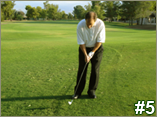
What you are trying to do is find the bottom of the arc. The leading edge of the clubhead has to swing DOWN into the ground in the downswing. By placing the golf ball in the center of your stance, this will provide you the best opportunity to do this.(#5)

Golf Chipping Lessons-Ball Position… the main goal in setting up properly is to not hit a fat chip. We know that`s a score killer and makes you feel stupid. I hope this helps.


More golf chipping lessons:

Here is Stan Utley on ” The Art Of The Short Game”…

The Art of the Short Game: Tour-Tested Secrets for Getting Up and Down [Kindle Edition]

?The hottest instructor in golf? (Sports Illustrated) takes on old-school gurus with a far more accessible, intuitive, and innovative approach to those essential chip shots, pitches, and bunker rescues.

Golf Chipping Lessons-Ball Position

Forgiving Sand Wedge

The sand wedge shotwas popularized in the thirties by Gene Sarazen and, now, the sand wedge shothas become routine for the tour pro. The tour pro has become very proficient at the sand wedge shot. To the point where they not just trying to get the sand wedge shot close, they are trying to make the shot.

Now, a lot of their effectiveness is due to the practice time they spend in the sand but much of their success is due to their understanding of the variables that go into hitting a good sand wedge shot.

We are going to take a look at 5 of these variables. Hopefully, this will help us hit better sand wedge shots, just like the pros.The Sand Wedge Shot1. What is the texture of the sand?

First off, you are not allowed to test the texture of the sand with your golf club or hand but you can feel the texture with your feet. Again, not digging around with your feet but just your normal walk into the bunker. The texture is important because this will tell you what club to use and how you should swing at it. The quick answer is that the firmer the sand the easier the golf ball will come out. But, we must be aware of the bounce in the sand wedge (that`s a whole article).

The bounce in the sand wedge won`t allow the club to dig. That`s why you blade sand wedge shots out of firm bunkers and on hard pan. So that, if you have a real firm bunker, you should not use a sand wedge but use a pitching wedge (less bounce). Bottom line, test the sand and choose the best club based on the texture.2. How long is the sand wedge shot?

The length of the sand wedge shot will determine how much you need to open the club face and how hard you must swing. Obviously, the longer the bunker shot the harder you must swing but, as much as possible, you should keep your swing effort the same for all bunker shot lengths and just change how much you open the club face. You can practice this, how much you open the club face, in the practice bunker.

Be aware, that you are adding more bounce to the sand wedge as you open the club face further. Consider using a pitching wedge or nine iron for real long bunker shots.3. What is the direction of the wind?

Here`s a great tip. Don`t practice sand wedge shots into the wind! The only factor here is that you need to take into account the wind factor. Obviously, adjusting your bunker shot to the wind conditions.4. How far is the golf ball going to roll after landing?

This one is pretty simple. Is the bunker shot uphill or downhill? Is it into the wind or down wind? Are you hitting the sand wedge shot off of a downhill, uphill or flat lie? All of these factors will determine how far the golf ball will roll out. The golf ball will roll less off of the uphill lie and, obviously, more off of the downhill lie.5. What kind of lie do I have?

Is it a clean lie, semi buried or fully buried lie. Out of a clean lie, you will be able to stop the ball on the green pretty well. Out of the buried lie, the ball will roll out. Also, out of the buried lie, you will need to close the club face to take some of the bounce off of your sand wedge. You will need the sand wedge to dig a little to get the golf ball out of a buried lie.
————————————————-
Hopefully, these golf tips will help you improve your sand wedge shots, just like the tour pro, and remember a little practice never hurts.

Driving The Golf Ball

Driving The Golf Ball… Five Tips To Improve 

There are many factors that go into hitting a good tee shot with the driver. This post, driving the golf ball, will look at five different factors.

As we step to the tee, with our driver or driving club of choice, we need to decide what is the best way to hit our drive in order to maximize our chances of making a par or better. Obviously, if this is our first time on the hole, there will be a lot more new input needed as compared to our home course where we have already processed a lot of this information.

This whole process takes place in a matter of seconds but is very important to our final result, a good or bad drive!

These five driving factors that we are going to review are in no particular order or importance.

Golf Driving Tips … Five Factors To Consider

1. Which side of the tee to tee up from?

If you are going to hit a fade you want to tee up on the right side of the tee and the left side if you are hitting a draw. By doing this, you give yourself the most room to hit your fade or draw. Remember, the golf ball must be between the tee markers but your feet can be outside the tee markers. Also, you can tee up within two club lengths behind the tee markers.

2. Are there any hazards to be aware of?

We need to know what danger might be in front of us. Is there a bunker in play and how far to it and to carry it? Is there a water hazard to be concerned with? If it`s a dogleg, how far to the turn in the dogleg? Maybe, we don`t need a driver to get to our ultimate driving result. In general, we need to do some thinking and just not step up and whack away with the driver.

3. Am I going to hit a fade (slice) or draw (hook)?

Based upon the hole layout, what is the most favorable shot shape, fade or draw. Much of this decision will depend on the length of the hole and the wind conditions, if any. We always want to use the wind to our favor, using a fade or draw to ride the wind on longer holes or keep the ball in play on shorter holes.

4. Which side of the fairway is most favorable?

Where is the best place to come into the green from. An example would be, there is a bunker or water hazard on the left side of the green. So, if we drive the ball down the right side of the fairway, we will not have to carry the bunker or water to get to the green. In general, we want to cut our risk factor any way we can.

5. What am I going to aim at?

This is one that many people forget. They just step up and hit their tee shot in a general direction. We need to choose a specific aiming point. Usually, it will be an object in the distance, such as a tree or other landmark. Many recommend an intermediate aiming point. Which would be a mark on the ground a few feet in front of you. Whatever you do, you need to have a definite aiming point and be totally committed to it.
————————————————————————-
I hope these five golf driving tips help you to play from the fairway and play better golf.
Creative Bunker Shots

How To Hit The Long Bunker Shots

Here is an article by Jack Moorehouse, author of “How To Break 80”, where he passes along some great golf tips on how to hit the long bunker shot.

Hitting A Long Bunker Shot


A green side bunker 20 to 30 yards from the pin isn’t where you want to be with an approach shot or a drive. But even the best of us find ourselves there occasionally. The long bunker shot from a distant bunker is one of the hardest shots for weekend golfers to make, if not the hardest.

Below are six tips for hitting a long bunker shot:

  1. Close your stance instead of opening
  2. Widen your stance a couple of inches
  3. Work your feet firmly into the ground
  4. Concentrate on just skimming the sand
  5. Rotate the club face open to closed

The keys to this shot are two adjustments in your stance. Since you want to make a long accelerating swing, you need a firm foundation. Widening your stance helps. So does working your feet into the ground. But don’t work them in so much that you can’t move them. In addition, close your stance. Your feet should be parallel. That lengthens your swing and makes it easier to bring the club into the ball from inside the line of play.

Use your sand wedge for this shot and focus on just skimming the sand as you go through the ball. Also, rotate the club face from open to closed on the downswing, which you can do by turning your right hand over your left through impact. Incorporating these adjustments into your stance helps you hit an accurate bunker shot.

We can’t stop ourselves from landing in a bunker 20 to 30 yards from the green. No one can. But good golfers get out in one. Hitting a long bunker shot will help you do that, keep your scores in check, and trim strokes from your golf handicap.

*****************************************************************************
Jack Moorehouse is the author of the best-selling book “How To Break 80 and Shoot Like the Pros!“. He is NOT a golf pro, rather a working man that has helped thousands of golfers from all seven continents lower their handicaps quickly. His free weekly newsletter goes out to thousands of golfers worldwide and provides the latest golf tips, strategies, techniques and instruction on how to improve your golf game.

Butch Harmon Golf Lesson

Butch Harmon Golf Lesson… learn the seven things that all great golfers do and learn who you should copy and how to do it.Here`s a Wikipedia outline of Butch Harmon…Claude “Butch” Harmon, Jr. (born August 28, 1943) is an American golf instructor and former professional player. He is the son of 1948 Masters Tournament champion Claude Harmon, Sr. and has been in the golf industry since 1965.Harmon is best known for having been Tiger Woods’ golf coach from 1993 to 2004, though they have since gone their separate ways. In April 2007, it was announced that Harmon would start working with Phil Mickelson. He has also worked with other major champions such as Ernie Els, Stewart Cink, Greg Norman, Davis Love III, Fred Couples and Justin Leonard, and with younger stars such as Nick Watney, Adam Scott, Dustin Johnson, Natalie Gulbis, and most recently Gary Woodland.

Butch Harmon Golf Lesson…

here`s an excerpt from the Golf Digest article…

7 Things All Great Players Do Here’s who you should copy—and how to do it

My time around great players started with my dad. He finished top 10 in 11 major championships and won the Masters in 1948. His closest friend was Ben Hogan. When they’d play practice rounds together, I’d tag along silently, asking a million questions afterward. My clearest memory of Mr. Hogan is how he could control his ball. He always left it in the right place, even when he missed. And he could control it through the air like nobody–high, low, draw, fade. It was incredible to watch. One day my dad asked me to play with him and Mr. Hogan. By then I was a know-it-all teenager, and I got all the way to the first tee before my nerves took over. I remember standing over that first shot: I was wearing a visor, and on my last look down the fairway I saw a pair of golf shoes out of the corner of my left eye. Mr. Hogan’s shoes. All those years watching him, and now he was watching me. I flared it right and didn’t settle down until he threw his arm around me a few holes later. Great players have a huge effect on us, because they excel at something we love to do. Here I’ll show you what I’ve learned from some of the top players I’ve coached. Some are things we worked on together; others, just like Mr. Hogan’s ball control, are things I simply marveled at. I’m sure these lessons can help you play better.

Read More at Golf Digest

Here`s a short video from Butch Harmon on how to hit from tight lies.