Why do we find a move that seems so easy to the professionals so incredibly difficult to perform?
Recently, I discovered that psychologists believe that we learn differently as adults than we do when we were children.
And I believe this may be the key to explaining why we have such a difficult time of it.
The large majority of professional golfers will have taken up golf when they were kids – Tiger Woods was swinging a club well at 3!
But … I would imagine the majority of amateur golfers took golf up when either in their late teens, early twenties or even later in life … as adults.
The psychologists believe that as children we learn from repeating the model that we see – we know that kids are very trusting of what they are told. Yes, they ask lots of questions but they trust the answers given. They see, and are told, and DO.
Now as adults we learn differently. We have already formed opinions about how the world is and how things operate. So when we learn something new we actually test it against the rules that we have already built up in our heads as to what is right and wrong.
Unfortunately for us, the golf swing is actually illogical to our adult minds. That’s where the problem stems from. In our heads we can’t actually accept or believe that that is how the golf swing works. We then trust our instinct and test it against our rules and go back to what we believe is logical.
Here is what is illogical about the golf swing:
A Golf Swing without Effort = A Powerful 300 yard drive
It’s been said before that the secret to the pros swing is that it achieves ‘Power WITHOUT Effort – how illogical is that!
It’s a bit like saying we’re going on a 200 mile car journey, but we’re not going to turn the engine on! No ones going to believe you.
That’s how our brains interpret it…we think there’s no way you can hit a golf ball 300 yards without LOTS of effort.
So next time we coil up on the back swing our brain tells our muscles ‘right guys we need plenty of effort if we’re going to send this ball long and straight’.
Pro’s do actually put effort into their swings to get the ball to go that far (look at Tiger Woods face just before impact and you’ll see what I mean) BUT they put it in at a completely different point in the swing to amateur golfers. They also know the technique that allows them to produce such great results …. and it doesn’t involve power, certainly not how the amateur golfer understands it.
Amateur golfers think you need to start the golf swing powerfully BUT the pro golfers know that you put the effort in at the bottom of the swing.
If you try and take this point on board this will start the process of adjusting your mind.
In my book … Golf Swing Eureka … I OPEN your EYES to how the golf swing actually works … much of which we amateurs don’t appreciate … and the answer to the question … why is the golf swing so hard?
Category: Golf training
Where Should The Golf Ball Be Positioned
Critical Ball Position Instruction Revealed
When you swing a golf club well you do so without any conscious thoughts. Or in other words you swing the club automatically using your subconscious mind. The better and more consistent your setup the more you’ll be able to swing automatically. And to back me up on this read this quote from Tiger Woods:
“Poor ball position is a silent killer. If you don’t place the ball precisely in relation to your stance, the ball will be playing you instead of you playing the ball. You’ll have to conjure up some type of weird swing movement just to get the club on the ball, and because of that you’ll never be consistent.”
Tiger Woods
So one huge determining factor as to whether or not you become a consistent ball striker will be where you position the ball in your stance and how consistently you get the ball positioned where it needs to be for each club. If your ball is positioned poorly then you’ll need to make a lot of compensations as you swing and this will mean you’ll greatly lack consistency.
So here’s where you need to position the ball in your stance to become a consistent ball striker.
For your Driver and 3 Wood your ball should be positioned directly off your left foot instep.
Then for your 2-iron through to 6-iron your ball should be positioned a ball width inside your left instep.
Important Note: If you’re using high lofted woods or hybrids then here is what I suggest. Anything up to 19 degrees in loft, e.g. a 5 wood should, use the driver ball position. Woods/Hybrids over that, e.g. a 21 degree 7 wood, should use the 2nd ball position that I suggest for 2 – 6 irons.
Finally for your 7-iron through to 9-iron your ball should be positioned two ball widths inside your left instep.
Now after seeing this you may be wondering why I teach three ball positions when it would be so much easier to have just one ball position. Well, here’s the reason.
When you swing a driver you need a more sweeping motion than you do with say a 5-iron. And if you had just one ball position for both of these clubs then you would have to adjust your swing consciously to produce the correct swing motion (i.e. a sweeping one for a driver and a more downward blow with a 5-iron) and that’s not good.
So work hard on getting the ball positioned correctly and consistently for each club you’re using and you’ll give yourself a great chance of becoming a consistent ball striker.
—————————————————————————–
Article used with permission from Nick Bayley (Professional golfer) who has discovered just one golf swing fault that could be stopping YOU from ball striking consistency and success.
But now you can take a simple 2 minute golf swing test to see if you have this swing fault or not.
Ultimate Golf Fitness Training
Ultimate Golf Fitness Training
Here is a guide to golf fitness training that could be very helpful, especially if you are in the off season.
Weight Training For Golf: The Ultimate Guide @ Amazon
Outline:
Weight Training for Golf is the most comprehensive and up-to-date golf-specific training guide in the world today.
It contains descriptions and photographs of the most effective weight training, flexibility, and abdominal exercises used by golfers worldwide, including the 2010 US Open champion, Graeme McDowell and World Golf Hall of Famer, Annika Sorenstam.
This book features year-round golf-specific weight-training programs guaranteed to improve your performance and get you results.
No other golf book to date has been so well designed, so easy to use, and so committed to weight training. This book enables golfers of all skill levels to add extra yardage to their drives and irons without having to buy the latest technology in golf. By following this program you can develop the flexibility and strength required to eliminate fatigue and increase distance with every club in your bag.
With stronger and more flexible muscles, you will not only hit the ball farther but you will have better control over all of your shots throughout the round. Most importantly, you will reduce your chances of injury and be able to play 18 holes without any problems.
Ultimate Golf Fitness Training Reviews:
1)I’ve been using workouts from this book for about a month now. I can really feel the difference! I’m more in tune with my core and mechanics. The workouts and illustrations are easy to follow. Fusser also covers other aspects of your life to help you achieve your goals. Kind of a “how to” of sorts. I’m looking forward to continued progress and success!
2)It’s time to replace your last-century voodoo concepts of training (and over training)for golf… of spending $500 a year on a gym membership. Frankly, I am convinced that Kai Fusser has written THE authoritative golf fitness book. It is clear and concise. That won’t stop others from exploiting this market, but this is the only book you will ever need on the subject. Put Fusser’s book along side Hogan’s “Five Lessons,” Watson’s “Getting It Up and Down from 40 Yards and In,” Stockton’s “Putt To Win,” and Rotella’s “Golf Is Not A Game of Perfect,” and you’ll have what are essentially the only golf books you’ll ever need to own.
The Golf Driver – How To Hit It Long And Straight
The Golf Driver – How To Hit It Long And Straight
Here is some straight forward golf driver advice from Nick Bayley, who has a very unique golf swing test that can be found at The Golf Swing Test.
Here`s Nick…
So often I have golfers come to me saying….
“I can hit my irons well but I greatly lack consistency with my driver. Can you give me some advice on what I need to do to hit my driver like my irons?”
If you resonate with that question then you’ll want to read this entire article now. Because in it I’m going to give you some simple tips to improve your driving off the tee. And the first thing we’re going to look at is your equipment. More specifically, I want you to look at the shaft in your golf driver.
You see, the shaft of any club is the most important aspect of the club that will affect performance. And if you have a shaft in your golf driver that is not suited to you then you’ll struggle to hit that club consistently well.
So when a golfer comes to me complaining about great inconsistency with their driver over their irons I routinely ask this question…
“Does your driver have a different shaft than your irons?”
And normally I get an answer back like this…
“Yes, but my irons have steel shafts in them and my golf driver has a graphite shaft in it. Although they are all regular shafts.”
Now what most golfers don’t understand is that because a shaft has regular on it does NOT mean it is the same flex as another brand of shaft that has regular on it. There are no standards as far as golf flex is concerned. So don’t ever assume that having the same shaft flex from two different companies means you essentially have the same shaft.
So my first advice to people that can hit their irons well but not their driver is to get the exact same shaft as is in their irons put in their driver. And 9 times out of 10 just doing this solves there driving problem.
Now in case that doesn’t solve your golf driver problem here are three more tips to help you to hit the ball better and further off the tee.
1. Before you take some full swings with a driver you should always warm up by doing some stretches. The golf swing is incredibly hard on the body and you’ll only do yourself damage by trying to swing a driver hard without warming up your muscles first.
2. If you tend to fight a slice with a driver you should tee the ball higher as this helps to promote a draw. Conversely if your problem shot with a driver is a hook you should tee the ball lower.
3. When you’re teeing up to hit a golf driver you need to take into account the shape of shot you’ve been hitting with the driver and then tee the ball up on the best side of the tee to allow for that shape.
For example, if you’ve been fading your driver (and other shots) and you’re faced with a long par 4 that doglegs to the left then you’re going to be in trouble if you leave your ball on the left of the fairway. So to give yourself the best chance of success you should tee the ball up on the side you most want to avoid. And in this case you don’t want to go left as you’ll be forced to hit a draw for your second shot and that’s not a shot you’re hitting well.
So with this in mind in this example you should tee the ball up on the left-hand side of the tee box so you’re aiming away from the left-hand side, and you should aim down the middle of the fairway. That way if you hit the ball straight you’ll be in the middle of the fairway. If you hit a fade you’ll be in the right hand side of the fairway and if you hit a little slice you’ll be in the right rough still with a good shot to the green.
You see, you’ve got to be smart when you’re teeing up your ball. And here’s a general rule to remember to help you do this…always tee up your ball as the same side as the trouble and aim away from it.
If you’re struggling to hit your golf driver well I’m sure if you put these tips into action you’ll hit your driver longer and straighter.
*******************************************
Nick Bayley is a professional golfer who has discovered just one golf swing fault that could be stopping YOU from ball striking consistency and success. But luckily for you, now you can take a simple 2 minute golf swing test to see if you have this swing fault or not. So don’t delay!
The Correct Golf Driver Loft
Choosing The Correct Golf Driver Loft
I`ll bet , like most of us, the last time you bought a new golf driver you hit a demo club at the range a few times, it felt good and you bought it.
This is how almost all of us buy new golf clubs. But let`s take a look at the driver. It is probably the most important club in the golf bag. Playing golf from the fairway is a lot easier than the rough and also, hitting a 9 iron to the green is a lot easier than hitting a 6 iron. That`s pretty obvious, so what`s the point?
The point is that most of us are not playing with a driver that has the proper loft to provide us with maximum distance and accuracy. The simple reason for this is that golf club manufacturers are not making drivers with the lofts that are correct for most golfers.
———————————————————————
Here`s an idea of the range of lofts that we are talking about to provide optimal driver loft: (source: Golf Engineering)
The numbers below represent (A)Clubhead Speed (how fast you swing the golf driver), (B)Estimated Optimal Driver Loft (your ideal driver loft) and (C)Category (who should be using these lofts)
(A)_____________(B)____________(C)
(1) 130-150…..4-7 degrees…..men long driving champs
(2) 110-125…..8-9 degrees…..men touring pros
(3) 95-105……10-11degrees….strong men & women
(4) 85-90…….12-13 degrees…most men golfers
(5) 75-85…….14-15 degrees…senior men & most women
(6) 65-75…….16+ degrees…..most women golfers
———————————————————————
As you can see, most men golfers should be using a 12-13 degree loft with their driver, senior men and women even higher and we know that this is not the case.
Also, what this validates is the fact that the average male golfer is better of driving with his 15 degree three wood. We have known this for years but we really did not know why, now we do. It is all about the optimal loft! There are more factors that control golf driver distance and accuracy, other than loft, but for our purposes today, this is one variable that we can easily control.
Now, we know that we are not going to give up hitting the driver. The grip it and rip it mentality is too deeply ingrained in us to give up our driver. But, at least now we can give up trying to hit an 8 degree driver and maybe change to a more sensible 10.5 degree or, even better, a 12 degree driver. The fact is that the lower degree of loft has been working against us and we never knew it!
So, stop fighting gravity and starting using a loft that will provide you with the optimal launch angle. Hit your driver longer and straighter. Give it a try, I think you will like it.
SKLZ Gold Flex Strength and Tempo Trainer

The gold flex is designed to help create the proper swing plane and also to build the muscles you need in the golf swing. Be sure to read the reviews and watch the video below to see some examples of how the gold flex can be used.
SKLZ Gold Flex Strength and Tempo Trainer
SKLZ Gold Flex Strength / Tempo TrainerStrengthen and condition golf-specific Muscles.The Gold Flex warm-up and tempo training aid is designed to improve your swing while providing a core muscle workout. The Gold Flex encourages a flatter swing plane and forces the downswing to be initiated by the lower body, both of which fight slices.SKLZ Gold Flex Strength / Tempo Trainer features: * Durable polyurethane head for frequent use * Shaft length helps flatten the swing plane * Flexible fiberglass shaft teaches lag and helps eliminate early release/casting * Golf grip with guidelines for proper hand placement * Head weight improves kinetic sequencing in the swing * Great low-impact stretch for pre-round warm-up * Fits easily in golf bag and is legal to carry on course * For right- and left-handed playersGold Flex: 48″ length, 1.8 lb. headGold Flex 40: Smaller size is ideal for many for seniors, ladies and juniors -40″ length, 1.5 lb. head
Reduce Your Golf Training And Lower Your Score
Andrew Scott has developed a mental golf tip for improving the golf skills in less than 30 minutes and without practicing, reduce your golf training and lower your score.
He tested and tweaked the method over the last 6 months to what it is now.
Mental golf training can be 5-6 times more efficient than practicing on the driving range.
The new AmazingGolfMind subliminal mental audios focus on improving the subconscious mind. By listening 3-4 times a week you’ll improve your game much faster than hitting hundreds of balls on the driving range.
Here’s the free video, mental golf tip, what explains how subliminal mental golf audios work:
AmazingGolfMind Video
Is this a new concept? It is a new concept for regular golfers. Tiger and the top tour pros use subliminal mental training for a long time. Tiger is said using subliminal messages since he was 13.
You can watch the free video on the mental golf tip here and get a free short game audio directly after watching the video:
Proper Golf Stance
Proper Golf Stance… learn to set up correctly for good golf shots
I`m sure that you will agree that, in order to hit the golf ball at your target, you must be correctly aligned or in the proper golf stance.
This resource has made easier for you to get into the proper golf stance every time! They have devised a little teaching aid called “Set Right” that will help you to get into the proper golf stance.
You have probably seen, or used the system yourself, golfers using two crossing clubs to check their alignment. This method is awkward and you never really know if you have the clubs set up properly. With “Set Right“ you can be sure that you have the proper golf stance.
“Set Right” is small enough to fit in your pocket or golf bag. It is something you can use every time you go to the driving range. After using it for a while, you will automatically get into the proper golf stance by developing the correct golf set up habits. “Set Right” is the first training aid guaranteed to get your foot and ball placement right so your alignment is correct and the ball finally goes where you want it to go.
This is a very handy golf tool and the best part is that it costs under $20.00 and comes with a 30 day money back guarantee.
Pro Hitting Golf Mat
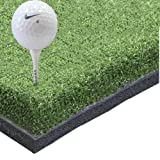
Mat measures 48″(inches) x 60″(inches) Made of 100% spring crimped nylon material. It will not fade, bunch, weather or leave marks on your clubs.The mat is 1.125″ thick bonded to a 5/8″ thick polyethylene foam using a specially engineered urethane stabilizing layer. The foam is added for dimensional stability. You do not need special rubber tees. No more hitting off of a predetermined height of a rubber tee. Our mat will accept a real wooden tee which allows you to choose different clubs you want to hit at different heights. Rubber tees also give you a different feel because they obstruct your club at impact. Our mat gives you that on the course feel. Our dense fiber mat allows you to feel the difference on a fat shot because if you go too deep the thick fibers will slow your club head speed resulting in a fat shot. In practice you will learn to eliminate your mishit shots. Our competitors golf mat will “bounce” which will result in mishit shots. Our mat lets you hit down and through the ball for better practice. Made in the USA
Practice Golf Swing
Is Your Practice Golf Swing Better Than …Your Real Golf Swing?
This is an excerpt from the book … Golf Swing Eureka … by Jon Barrett
“Why is my practice golf swing often better than my real swing”?
When I understood the answer to this question it made a big difference to my golf swing.
How many golfers do you see on the tee making a nice free practice golf swing and then duff or slice the ball with their real swing?
It happens doesn’t it … it happens a lot.
Well … I came to realize that when I understood the journey that the golf club needs to take around your body then I also realized where so many amateur golfers were going wrong with the difference between their practice swing and their real swing.
You see when you understand that the golf swing is about technique not aggression then your body starts to work differently.
When you make your practice swing you remain relaxed and free moving. When you make your real swing you immediately start to tense the big muscles in your body particularly your back and shoulders.
Your brain starts telling you body ‘look guys if we want to hit this ball a mile then we need to put loads of effort it’ – WRONG!
Next time you swing – remember to keep your back and shoulder muscles relaxed so that your real swing is as good and as free as your practice golf swing.
Remember the proper and most efficient golf swing is all about technique not aggression.
The answer to this question lies in the way we think the golf swing works – we need to convince ourselves that the Pro Golfers swing works – Power without effort – and we too will follow their lead.
A good exercise to demonstrate that loose muscles work better than tense muscles is to try running down your garden with loose muscles then tense your muscles and try again – the difference is dramatic isn’t it and the golf swing is no different, we need to keep our muscles relaxed for them to work effectively.
Tensing prior to moving doesn’t help – you need to relax to let your muscles work properly at the right point in your swing. One of the main problems that generates this tensing motion is caused by the way many amateur golfers practice. How many golfers have you seen at the golf range who go straight for their driver and start trying to knock the ball out of the range?
Many I would guess. These golfers are simply trying too hard. Golfers should concentrate on accuracy on the range not distance i.e. how close can I hit it to a line from me to the target?
One way of practicing that takes out the need to try and knock the skin off the ball is to use plastic balls, you know the ones you can by from the golf shop. Once you start hitting these balls you quickly realize you can’t hit these balls 300 yards so don’t try to.
It results in you concentrating far better on technique. They also have the added benefit that you only need about 30 yards of space to practice in.