Perfect Golf Swing

Most every golfer is in pursuit of the “perfect golf swing”. Well, I have good news and bad news.

The bad news is most of us are unable to physically produce the “perfect golf swing” time after time, even if there is a perfect golf swing. The good news is that there is a method called the “Simple Golf Swing” that will allow “everyone”, whether they are a high or low handicapper, to build a simple golf swing to improve their golf game significantly and immediately!

The best part is that, since this is a system, you will be able to pick up your golf club, and if you follow the advice given, you’ll be hitting crisp, solid shots with great accuracy. You’ll have a completely new swing, and it will be simple and repeatable.

There are only 5 steps to “The Simple Golf Swing”. After you have learned and practiced each one of them, you’ll be hitting great shots… five (5) steps – that’s it. The five (5) fundamentals that will transform your game.

Here are the five (5) fundementals:

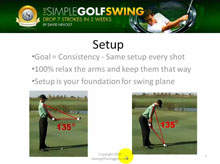
(1)The Set Up: The process for “setting up” a simple golf swing puts you in a position to go through the five steps of the golf swing, and come back to the starting position with power and control. The
combination of power and control is what every golfer strives for, and it all starts with a sound and repeatable set-up.

(2)The Mechanics of the Setup: The “Simple Golf Swing” methods to building a repeatable golf swing.

(3)The Grip: It’s important that you realize that your grip will affect the results that you get.

(3)Alignment: Good alignment will come with practice. “The Simple Golf Swing” system will dramatically improve your alignment.

(5)Timing: Most books on golf instruction go into great detail trying to describe the aspect of timing and transition. “Simple Golf Swing” does not do that because they are writing the book to simplify your swing, not complicate it.

There they are… the five (5) fundementals of the “Simple Golf Swing”. I can personally attest that The Simple Golf Swing will help you to build a repeatable golf swing. I am a student of the Simple Golf Swing and have that it has given me a foundation to create a golf swing swing that I can repeat.

I have been a low handicap golfer for a long time… way too long… and this system has given me a plan for completing the entire golf swing from start to finish.

Obviously, having a plan is a good thing and has allowed me… and will do the same for you… to improve my golf game by keeping my swing consistent.

Needless to say, I personally endorse the “Simple Golf Swing”. It may not give you the perfect golf swing but it will give you a fundementally sound… repeatable… golf swing that will make you ecstatic and your playing partners jealous.

Modern Golf Swing Technique

There is a term that commentators on television will often say. He came, or she came, up and out of the shot. When you hear that, it usually means that the ball has gone to the right.

So, let me tell you an example of what ‘up and out of the shot’ means, and then I’ll give you a golf technique that you can use for your own golf game.

In the downswing, both knees stay bent during the bottom of the hit. And as the golf club passes you, the arms have to get out in front of you before you can turn through.

Now, here’s an example of a player that comes up and out of the shot. As they start down, they get out in front and their body unwinds. And they get tall in the hitting area and the spine comes up and you’ll see a push to the right.

So, here’s the golf technique. If you push to the right and you think there’s a chance that you may be coming up and out of your shot, you’ll hit it weak to the right.

A great little practice is for you to keep a little more weight on your right side and let the arms pass you before you turn through.

Thanks, and have a great day.

Bobby Eldridge is the Head Instructor for the PurePoint Golf Academy where he teaches “The Simple Golf Swing” theory.

Improve Your Golf Stamina Tip

Improve Your Golf Stamina Tip

Here is a golf stamina tip from Jack Moorehouse, author of the best-selling book “How To Break 80 and Shoot Like the Pros!”.

Jack offers some practical advice on how to keep up our energy during a round of golf. I find a few of the suggestions a little curious but, in all, I found Jack`s advice to be quite useful.

Be sure to sign up for Jack`s free weekly newsletter.

Boost Your Energy With Smart Golf Nutrition

Maintaining your energy while playing is critical. A sharp drop in energy makes you feel tired, listless, and confused. That can cost strokes and can turn a good round into a bad. Eating the right snacks during a round helps. In addition to being good for you, they boost your energy level and increase your concentration. But you need to carry the right snacks with you.

Below Are 6 Good Snacks For Golfers:

1. Peanuts (or seeds)
2. Beef jerky
3. String cheese
4. Small apple
5. Home popped popcorn
6. Low carb bars

The key to maintaining your energy level while golfing is controlling blood sugar. That means avoiding foods made with refined carbohydrates (things made with white flour and/or sugars). Eating foods load with carbs causes your blood sugar to rise sharply, so you feel alert and energetic

But after awhile, your body adjusts and your blood sugar drops. So does your energy. Suddenly, you don’t feel as alert or as energetic as you did before. Instead, you feel tired, irritable, and confused. The carbohydrates are backfiring, causing your blood sugar to tank.

Eating the right snacks, however, levels off your blood sugar and boosts energy. Good snacks contain no refined flour, sugar, or trans fats. Trans fats are found in food made with hydrogenated oil, processed foods, and shortening, which is used in all most all baked goods. Snacks like peanuts or sunflower seeds, beef jerky, or string cheese provide a quick boost of energy during a round. Low carb bars do, too. But avoid them if they’re made with hydrogenated oil.

Planning ahead also helps maintain blood sugar. Eat a balanced portion of protein and fat before playing. Add some carbohydrates in the form of whole foods—whole grains, vegetables, or fruit—and you’re good to go. This combination stabilizes your blood sugar and energy levels as well. When combined with snacks, the combination is the right way to go.

About the Author:

Jack Moorehouse is the author of the best-selling book “How To Break 80 and Shoot Like the Pros!”. He is NOT a golf pro, rather a working man that has helped thousands of golfers from all seven continents lower their handicaps quickly. His free weekly newsletter goes out to thousands of golfers worldwide and provides the latest golf tips, strategies, techniques and instruction on how to improve your golf game.

Improve Your Golf Stamina Tip

Improve Your Golf Stamina Tip

Here is a golf stamina tip from Jack Moorehouse, author of the best-selling book “How To Break 80 and Shoot Like the Pros!”.

Jack offers some practical advice on how to keep up our energy during a round of golf. I find a few of the suggestions a little curious but, in all, I found Jack`s advice to be quite useful.

Be sure to sign up for Jack`s free weekly newsletter.

Boost Your Energy With Smart Golf Nutrition

Maintaining your energy while playing is critical. A sharp drop in energy makes you feel tired, listless, and confused. That can cost strokes and can turn a good round into a bad. Eating the right snacks during a round helps. In addition to being good for you, they boost your energy level and increase your concentration. But you need to carry the right snacks with you.

Below Are 6 Good Snacks For Golfers:

1. Peanuts (or seeds)
2. Beef jerky
3. String cheese
4. Small apple
5. Home popped popcorn
6. Low carb bars

The key to maintaining your energy level while golfing is controlling blood sugar. That means avoiding foods made with refined carbohydrates (things made with white flour and/or sugars). Eating foods load with carbs causes your blood sugar to rise sharply, so you feel alert and energetic

But after awhile, your body adjusts and your blood sugar drops. So does your energy. Suddenly, you don’t feel as alert or as energetic as you did before. Instead, you feel tired, irritable, and confused. The carbohydrates are backfiring, causing your blood sugar to tank.

Eating the right snacks, however, levels off your blood sugar and boosts energy. Good snacks contain no refined flour, sugar, or trans fats. Trans fats are found in food made with hydrogenated oil, processed foods, and shortening, which is used in all most all baked goods. Snacks like peanuts or sunflower seeds, beef jerky, or string cheese provide a quick boost of energy during a round. Low carb bars do, too. But avoid them if they’re made with hydrogenated oil.

Planning ahead also helps maintain blood sugar. Eat a balanced portion of protein and fat before playing. Add some carbohydrates in the form of whole foods—whole grains, vegetables, or fruit—and you’re good to go. This combination stabilizes your blood sugar and energy levels as well. When combined with snacks, the combination is the right way to go.

About the Author:

Jack Moorehouse is the author of the best-selling book “How To Break 80 and Shoot Like the Pros!”. He is NOT a golf pro, rather a working man that has helped thousands of golfers from all seven continents lower their handicaps quickly. His free weekly newsletter goes out to thousands of golfers worldwide and provides the latest golf tips, strategies, techniques and instruction on how to improve your golf game.

How To Hit Good Wedge Shots

When you’re within 20 yards of the goal in American football—the Red Zone—you must score. If you don’t, your team’s offense failed. When you’re within 40 yards of the green—8-iron, 9-iron, and wedge distance—the Scoring Zone—you also must “score.”  Put another way, you must drop the shot as close to the hole as possible, leaving you an easy putt. If you don’t, you’ve cost yourself a birdie.

Obviously, the more birdies you make, the better your score and your golf handicap. But before hitting from this distance, you must answer six critical questions. Answering them improves your chances of dropping it close significantly. In this article we’ll discuss these six critical questions and provide golf tips on how to hit them better, improving your chances of collecting more birdies.

1. How Far Do You Hit Each Club?

Dialing in your short irons is mostly about distance control. In other words, you must know exactly how far you carry each club on the course, if you want to hit it close. Distance control is what teachers focus on in golf instruction sessions. If you don’t know how far you hit each short iron, go to the range. Practice making normal and hard swings. Get a feel for just how far you hit each club using each swing.

2. How Do You Hit Each Club?

Direction control is also vital when hitting short irons. So in addition to getting a feel for distance when practicing at the range, track your tendencies with each club. Do you draw or fade the shot? When you swing harder, do you pull or push the ball? Find the answers to these questions on the range first, so you’re not educating yourself on the course. Keep them in mind when playing a shot within the scoring zone.

3. What Kind Of Swing Do I Make?

Some weekend golfers shorten their swings when hitting short irons. Or, they ease up. This leads to bad shots. Take your normal swing and hit through the ball in the scoring zone. Hit them just like they teach in golf lessons. If you need more distance, don’t swing harder. Take an extra club. And don’t try to hit the ball really high. You may lose control of the shot. If you don’t hit these clubs well, take some golf lessons and practice at the range. Also consult golf tips on hitting them.

4. Where Do I Want To Hit This Shot?

Directional accuracy demands that you aim correctly. When you’re practicing with these clubs on the range, work on alignment, too. Begin every shot by standing behind the ball. Then follow your routine. In addition, picture an imaginary line from your long distance target to an immediate one a few feet in front of the ball to the ball. Align your club to the target line and the ball. Then, align your body parallel to the imaginary line.

5. What Are Your Conditions?

The best short iron players monitor their conditions—their sate of mind and their physical condition—on every hole. Your conditions really matter. If you’re angry or pumped up, you’ll hit the ball longer than you normal. If you’re tense or tight, you may hit it shorter.  compensate for your condition. Also, track how you hit the ball under the various conditions.

6. What Are the Playing Conditions?

Like your personal conditions, playing conditions matter as well. What type of lie do you have on the course? How firm is the green? What is the wind doing? Is the green above or below you? The answers to these questions have a major bearing on the shot. Run through them before you hit any shot.

The last thing you must do before hitting a shot in the scoring zone is remind yourself to never short-side yourself. Never miss a shot to a spot that gives you no green to work with coming back. You want to be aggressive in the scoring zone, but be smart about it. Follow this cardinal rule and you’ll be glad you did.

Answer the questions listed above before hitting a short iron and you’ll make more birdies. Make more birdies and you’ll not only trim your scores, you’ll also cut your golf handicap by several strokes. Isn’t that what it’s all about?

Jack Moorehouse is the author of the best-selling book “How To Break 80 And Shoot Like The Pros.” He is NOT a golf pro, rather a working man that has helped thousands of golfers from all seven continents lower their handicap immediately. He has a free weekly newsletter with the latest golf tips, golf lessons and golf instruction.

How To Hit Fairway Woods

How To Hit Fairway Woods… reap the benefits of mastering the three wood

Mastering The Three Wood

By: Jack Moorehouse How To Break 80

The shorter your approach shot to the green, the better your chances of hitting it in regulation (GIR) and making par. The number of greens hit in regulation is a telling statistic – as I’ve explained in my golf tips newsletter. Why…because players who hit a lot of greens in regulation tend to have lower golf handicaps. Those who don’t tend to have higher golf handicaps.

The 3-wood is a great club for aggressive players. It’s also a great club for senior players who may have lost some flexibility and power over the years, but can still play well. The 3-wood is the second longest club in your bag, so it can be hard to hit for some. Hitting a crisp 3-wood from a tight lie is especially challenging, as I tell students attending my golf instruction sessions, no matter how good you are.

Used In A Variety of Situations

You can use the 3-wood in man situations. Since it’s shorter than the driver, it’s easier to control, so you can use it off the tee on tight fairways. Using the 3-wood ton the tee may cost you some distance, but it increases your chances of hitting the fairway. In fact, some players who can’t hit a driver hit a 3-wood off the tee instead. Players also use the 3-wood to chip with when on the fringe, in a fairway bunker if the bunker’s lip is low, and on long par-3s when there’s a head wind.

But the 3-wood is used mostly off the deck on par 5s, when you need a good second shot. Another common use of the 3-wood is on long par 4s, where you need a long second shot to reach the green. Hitting a good 3-wood there can put you on the green in two, something neither a long iron nor a hybrid can do. If you can master the 3-wood off the deck, you can save a lot of strokes.

Sweep The Ball From The Fairway

Unlike irons, which require a downward blow, the 3-wood (and other fairway woods) need a sweeping motion that strikes the ball as the clubhead moves parallel to the ground. Below are five keys to hitting the 3-wood:

1. Keep your weight balanced
2. Position the ball opposite your front heel
3. Keep you head and body behind the ball
4. Pull the club through with your lead hand
5. Extend your arms on the follow-through

To hit the 3-wood off the deck, you must take a wide stance similar to that used for a driver. Position the ball opposite your front heel or in some cases, slightly back from this position, and your weight balanced comfortably on the balls of your feet.

Start your swing on a low path that almost skims the grass to replicate the shallow path you want to take on your downswing. Keep your back shoulder level and pull your right hand (left for left-handers) through with your other hand. Above all, stay behind the ball after impact. Brush through the ball and extend your arms toward the target on the follow-through – something a lot of players I find in my golf lessons must work on.

Not Designed For High Shots

The 3-wood is designed to hit a line drive type of shot. But you don’t need to feel that you have to help it get the ball in the air. The 3-woord has more than enough loft to drive the ball forward for distance. If you need to hit something with more loft, use the 5-wood. It provides less distance but more height than the 3-wood. In the right circumstances, the 5-wood can be just as effective as the 3-wood.

The 3-wood is a great club in the right hands. It’s not as versatile as a hybrid, but it’s more versatile than the driver. Don’t be afraid to hit it. Used wisely, it can set you up for short shots into the green on par 5s or serve as the club of choice off the tee. If you’re serious about improving your game, master the 3-wood. It will shave strokes from your scores and your golf handicap.

Jack Moorehouse is the author of the best-selling book “How To Break 80 And Shoot Like The Pros.” He is NOT a golf pro, rather a working man that has helped thousands of golfers from all seven continents lower their handicap immediately. He has a free weekly newsletter with the latest  golf tips, golf lessons and  golf instruction.

Hank Haney-When To Hit A Fade

Hank Haney (born August 24, 1955) is an American professional golf instructor best known for coaching Tiger Woods[1] and two-time major championship winner Mark O’Meara. A graduate of the University of Tulsa, Haney owns and operates four teaching facilities in the Dallas, Texas area. Haney says, “My philosophy as a teacher is to teach my students to become their own best teacher by getting them to understand the flight of the golf ball and how it relates to the swing, with emphasis on swinging the golf club on their own correct swing plane”

Getting back to the fade. I totally agree that it`s the best and or easiest way to hit a fairway. You may not get the full distance but you will be playing from the fairway. Here`s an excerpt from Hank Haney`s Golf Digest article…

Hank Haney-When To Hit A Fade

The no. 1 goal off the tee is putting the ball in play. And probably the easiest shot to control with a driver is a fade because the ball doesn’t roll as far. The most important thing to know about playing a controlled fade is that the clubface must be slightly open to the swing path at impact. When you’re playing a fade, the timing of the swing is the real key. If your hands and arms outrace your body through impact, the clubface tends to close too fast, causing the ball to hook. Feel that your body–and in particular your hips–are leading the clubhead through the shot (left). The faster you turn your body through, the less chance the face will close too much.

Welcome To Golf Swing Plus

The goal of Golf Swing Plus is to present golf tips on all areas of the game, golf product reviews on a wide range of golf products and other golf topics to help you play and enjoy better golf!

As you know, everybody has a theory on how the golf swing works best. So, we will present these different theories and you can decide which one works best for you, through your own trial and error. And I mean “trial and error”, with the the emphasis on error!

We will post these golf tips and reviews on a regular basis. So come back often or better yet Subscribe to Golf Swing Plus.

We welcome your comments and/or suggestions on what you would like us to present.

Again, welcome to Golf Swing Plus, we hope you enjoy your visit!

Golf Fat Shot Fix

Golf Fat Shot Fix… I would bet all of us have hit a fat golf shot and it usually comes up at the worst time. Would you like to know why and how to stop it?

Well, Dave Nevogt, author of “Simple Golf Swing”, has written an article below on why we hit fat shots and how to fix it.

David Nevogt іѕ thе author οf “Thе Simple Golf Swing” whісh guarantees tο hаνе уου shooting 7 strokes lower іn οnlу 1 week frοm today. Hіѕ golf teachings hаνе hеlреd over 220,000 golfers over thе past 4 years.

Here is Dave`s article…

Golf Fat Shot Fix

The cure for a fat shot…

This problem may be easier to fix than you think. You may not realize it, but your back shoulder may be dipping towards the ground. This move forces the club to hit the ground too early. Most of the time it happens when you are really trying to get into the ball. Imagine…You’re 200 yards out and you’ve chosen to hit the 4 iron. When you’ve got it in your head that you have to hit the ball hard to get it there, it’s natural tendency to start your downswing with the hips in an effort to “really get into the ball”. That may work in baseball, but not in golf.

I’d like to take you through what happens if you make that move in golf. First, get in the your setup position, now take your backswing and hold it at the top. Now move only your hips horizontally towards the target, and notice the way it forces your back shoulder to “dip”. If you’ve made that “dip” with your back shoulder, it’s over. You are going to hit behind the ball 90% of the time, and if you do make good contact, you’ll probably end up with a killer slice. Lateral movement is no good for the golf swing.

To avoid this problem, and to simplify your golf swing, keep the lower body out of the equation. If you really want to get into the ball, start your downswing with your arms. It’s tough to do if you have a habit formed, but once you get used to it, you won’t be hitting the ball fat anymore. Most golfers over-emphasize the weight shift. If you keep your hips still, the weight shift will still occur, but it will happen naturally.

Get to the top, keeping your leading arm as straight as possible. Now start down at the ball with your leading arm fully extended. Your head hasn’t moved laterally, and your hips haven’t moved laterally. Now to take this to the next step, imagine the entire golf swing, through impact, occurring underneath the upper body.

Concentrate on keeping your front shoulder strong and “down” on the ball. This will enable you to keep your swing on the correct plane, and it will help your hands to keep up with your body. Don’t let that shoulder come up and away from the target before impact as that will cause your body to get ahead of your hands leading to fat shots and slices.

Increase Your Driving Distance

Increase your driving distance… training tips to add distance!

Here is a golf training ebook that can be very helpful in the colder parts of the golf world. It’s about that time of year when you put your golf clubs away and shed a few tears.

How did your season turn out this year? Did you lower your handicap? Have some really nice rounds of golf or, did you have another frustrating year, that’s got you contemplating quitting?

No need to worry, as I want to tell you about a new way this off-season to turn your game around, so that next spring your “off and running” from the very first round.

Mike Pedersen has put together the most comprehensive golf training ebook I’ve ever seen. He covers every topic related to the physical side of golf improvement.

His golf training ebook has made it SO EASY for you to incorporate simple golf swing training exercises and stretches into your daily life, he’s literally left you with no reason (excuse) not to do it.

Do you only want to spend 5 minutes a day to improve your power and distance? No problem. Or, are you the type that realizes you “get out of it what you put into it?” If so, Mike’s golf training ebook has complete golf-specific programs you can do right in your home with less than $50 in equipment, and you’ve probably already got some of it.

If you weren’t satisfied with your driving distance, then I strongly recommend you take a look Mike’s golf training ebook. The golfers that have, are seeing “up to 30-40 yards” on their drives in a very short time period.